/ 4 min read
The collapsing middle of product design
AI is compressing the production-heavy middle of the design process, shifting design toward understanding what deserves to be built and owning the experience of what gets built.
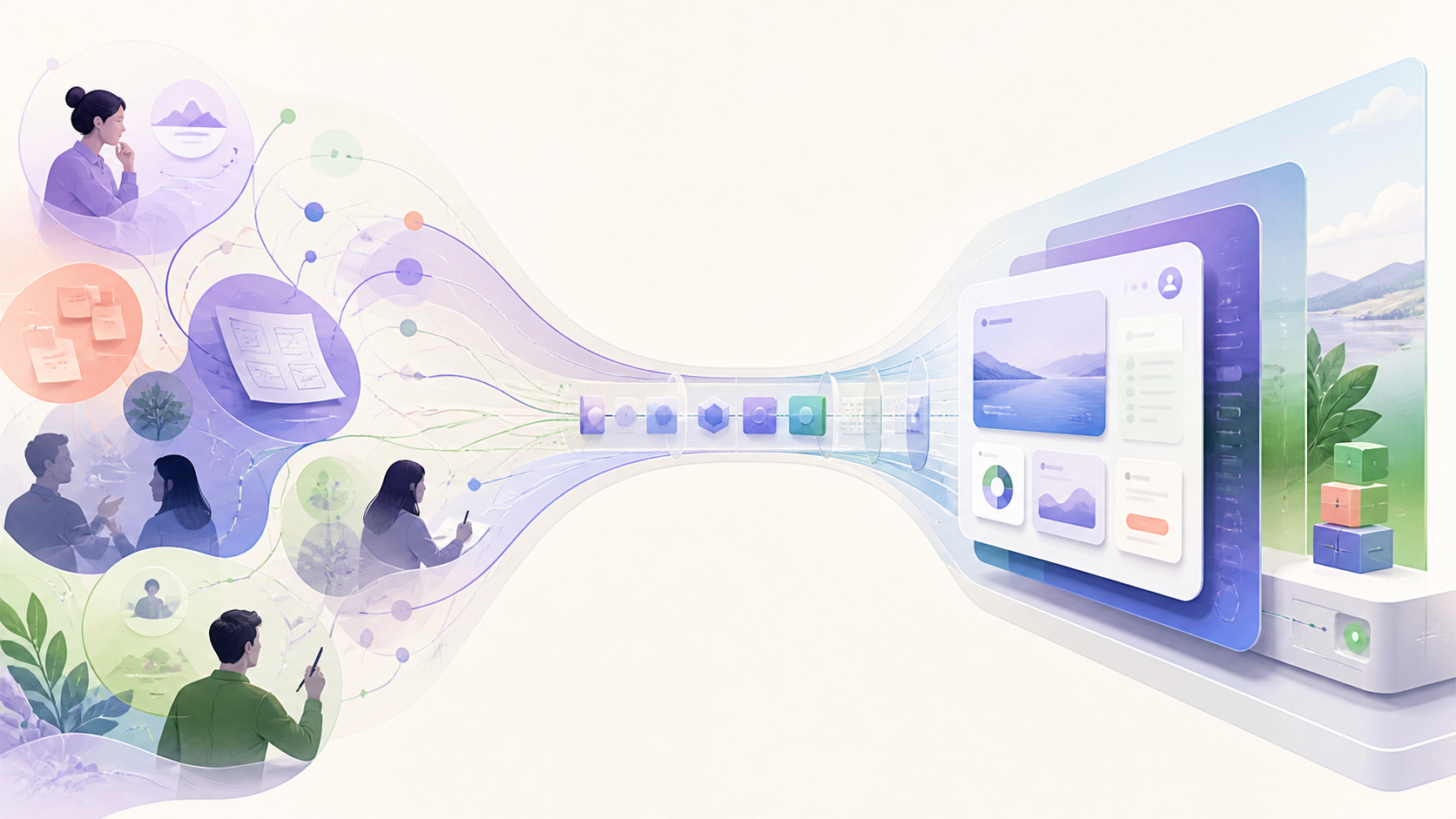
The traditional design process has a broad middle: synthesizing research, mapping flows, producing screens, maintaining the design system, and preparing a hand-off. Much of the work turned decisions into artifacts someone else needed to build.
AI is compressing that middle fast.
Given well-collected research data, it can produce a first set of themes. Given a specification, it can create a prototype. Given a component library, it can generate variants, documentation, and a first implementation. Judgment and review remain essential, but getting to a credible first version takes far less production effort.
The middle will continue to exist. Its role is changing from specialist production work into shared, increasingly automated infrastructure. That shifts design toward understanding what deserves to be built on one end and owning the customer-facing experience fully on the other end.
What is actually collapsing
The middle is a collection of different activities moving at different speeds. The fastest change is happening where the direction is clear enough to produce structured output: an initial synthesis, a documented flow, interface variants, design-system documentation, a high-fidelity prototype, or front-end code based on established components.
Consider a familiar workflow. A team finishes a round of interviews. A designer organizes the notes, identifies themes, maps a flow, builds screens in Figma, documents the states, and hands everything to an engineer who builds it in code. The time it took to perform those activities is collapsing.
With AI assistance, the notes can be clustered for review, the flow can become a working route using the existing component library, and screens can be generated in the actual front-end stack. The team reaches something testable much earlier and in higher fidelity.
The difficult questions are still waiting. Did we speak to the right people? Did we interpret the problem correctly? Which edge cases matter? Does the intervention work? The time saved in production creates more room to investigate those questions.
The design engineer owns implementation quality
One emerging role is the design engineer: a hybrid practitioner accountable for the quality of the customer-facing implementation. This might be a designer with some front-end skills or a front-end engineer with design expertise. The defining characteristic is responsibility for how the experience works when it ships.
AI coding tools have lowered the barrier to contributing directly to the front end. They can generate code, suggest components, and check a change against accessibility and design-system rules. Meaningful ownership still requires a level of technical fluency and responsibility for the codebase.
A Figma file can show the intended experience. A design engineer carries it into a product with real data, permissions, accessibility, legacy decisions, and an existing component library.
Finding the problem worth solving
Another direction moves closer to product strategy, concepts, and deeper research. The title might be product director, design director, or senior product designer. The responsibility is to make a clear bet about where the product should go.
That starts with understanding people in context. Who is struggling? What are they trying to accomplish? Which constraint matters most? A user asking for an export button may be revealing that they do not trust the information on screen. A request for more configuration can point to a basic task that has become too hard.
AI can organize notes and challenge a team's interpretation. Product judgment connects those signals with business priorities and technical possibilities. It determines which problem deserves attention and which intervention is worth testing.
These two directions are prominent, but they are not all there is. Many designers will work across them, while others deepen specialties such as service design, accessibility, content, experimentation, or systems thinking. The common shift is away from artifact production as the primary source of value.
When everyone thinks they can design
AI agents are giving product managers, business analysts, designers, and engineers more power to create flows, screens, and working interfaces. The traditional product triad is blending. Everyone is shaping the user experience, deliberately or otherwise.
That brings speed and a new risk. People tend to optimize from the context they know best. A product manager may focus on delivering a requirement. An engineer may focus on a clean technical solution. Each decision can be sensible in isolation.
Someone needs to ask whether a new flow fits what people already know, whether a request points to a real need, and whether the product remains understandable as a whole. Without that perspective, a team can move quickly toward a product that is internally logical and increasingly difficult to use.
Strong design judgment creates coherence across these local decisions. It preserves familiar patterns, clear language, thoughtful interaction, and the simple principle that people should not have to stop and figure out the interface. The design role can protect that whole without becoming a gatekeeper for every screen.
The middle becomes infrastructure
AI prototyping is reducing the need to design polished interfaces in Figma. Teams can move from an idea to a working prototype using an agentic design system, experiencing interactions with real behavior and constraints much earlier. Figma remains useful as a lightweight shared canvas for quick sketches, presenting directions, and gathering feedback. Its role in detailed product design is getting smaller.
That makes the design profession more interesting. Designers can spend more time learning what matters, shaping product direction, and improving the experience where people actually use it. The middle becomes infrastructure supporting that work.